Key takeaways
- One real maths half-yearly mock test (80 marks, 32 questions, 7 pages, a phone scan) was checked by a teacher and, separately, by Evalezy.
- The teacher gave 48/80 with ticks and crosses only; Evalezy gave 40/80 with 12 written notes.
- Evalezy caught 2 slips in the working that the teacher had ticked. The teacher was right on 5 answers that Evalezy misread. 3 were half-mark judgement calls.
- Every Evalezy misread was a reading problem (a minus sign, a crossed-out number, a 7 read as a 1), not a maths problem.
- The lesson: AI first check plus teacher review beats either alone. That is why Evalezy’s marks are drafts until a teacher releases them.
Background
Maths is where teachers are most sceptical of AI checking, and with reason. Answers mix numbers, symbols and working; a single minus sign changes a right answer into a wrong one; and students cross out and rewrite. We wanted to see, on a real copy, what an AI checker gets right that a busy teacher misses, and the reverse.
How we ran it
- The copy: a maths half-yearly mock test, 80 marks, 32 questions, 7 pages, photographed on a phone.
- The teacher: checked it by hand in green, the normal way: ticks, crosses and marks, no written notes.
- Evalezy: checked the same scan in red, from a marking scheme it drafted. No question paper was supplied.
- The review: we went through every question where the two disagreed and checked the student’s working by hand.
Results
| Teacher | Evalezy | |
|---|---|---|
| Total | 48/80 | 40/80 |
| Written notes on the copy | 0 | 12 |
| Slips in the working caught | — | 2 the teacher had ticked |
| Right answers marked wrong | — | 5 (handwriting misreads) |
| Half-mark judgement calls | 3 | 3 |
Most of the 32 questions matched. The 10 that did not are below.
What Evalezy caught
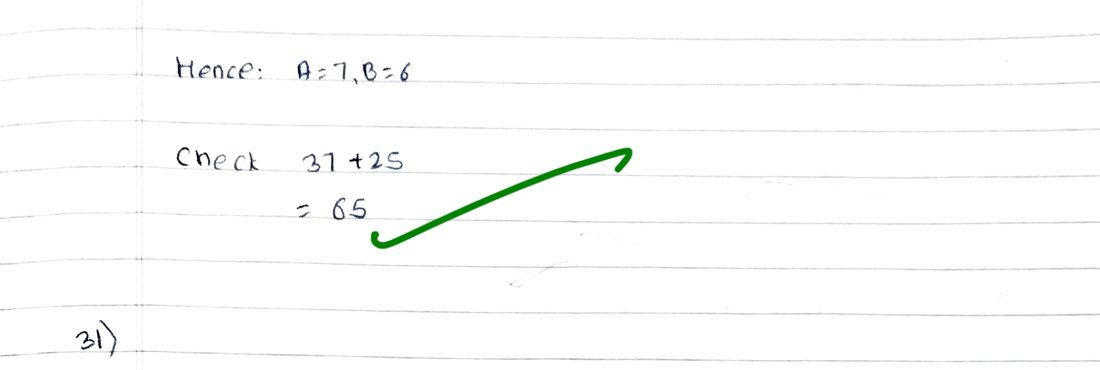
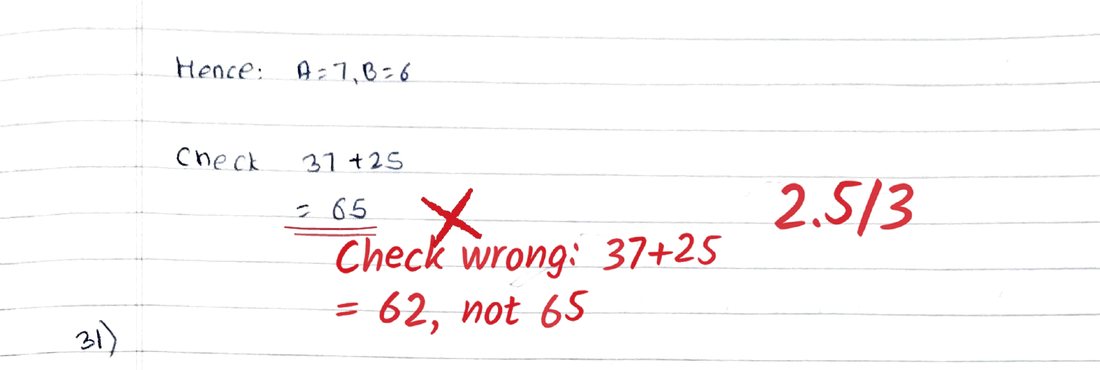
Q30: A = 7, B = 6; check: 37 + 25 = 65
The student’s own check says 37 + 25 = 65. It is 62. The teacher ticked it; Evalezy crossed it and wrote the right sum. The answer was right, so the slip cost half a mark.
Q28: 625t⁴/2, via × 25/2 t⁻⁸
Dividing by (2/25)t⁻⁸, the student wrote × 25/2 t⁻⁸ where it should be t⁸. The final answer is right; the working isn’t. The teacher gave full marks, Evalezy took half a mark and said why. (Evalezy also crossed one correct line, 5⁻³ = 1/125, by reading the 5 as a 6.)
What the teacher got right
Q18: (c) ₹720
The student chose (c), the right option. Evalezy read ₹720 as ₹120 and marked it wrong, while its own note names (c) as correct.
Q6: (b) −19/7
The student chose (b) and did write the minus sign. Evalezy missed the small minus and marked a right answer wrong.
Q25: 7/30
The boxed answer is 7/30, which is right. Evalezy read the 7 as a 1, took a mark for a “missing” factor, and its note was cut off mid-sentence.
Q26: 350 km (corrected from 360)
The student struck out 360 and wrote 350 above it. Evalezy read the crossed-out number and gave 0/2, while naming 350 km as the right answer.
Q29: x = 5, y = 5 (both boxed)
Both values are boxed on the page. Evalezy took half a mark for not stating them.
Judgement calls
On 3 questions the two differed by half a mark on how strict to be. Without the question paper these are not verdicts:
- Q27: The answer is right. Evalezy wanted the student to show that 900 divides by 6, 9 and 15; the teacher didn’t. A strictness call.
- Q32: Both took marks for the missing part (ii); they differ by half a mark. Evalezy’s note for this question was printed at the foot of page 4 by mistake.
- Q22: Evalezy took half a mark for unclear exponent steps; the teacher gave full marks. Settling who is right needs the question paper, which we don’t have.
Lessons for schools
- The AI reads every line; the teacher reads handwriting better. Evalezy’s catches were in the working that a teacher skims when the final answer is right. Its misses were all misreads.
- Review is where the time goes, and it is fast. Each AI mark comes with a reason, so a teacher sees “0/2: Correct answer: 350 km” next to a page that says 350 and changes it on the spot.
- Written notes are the hidden win. The teacher’s copy had 0 notes; Evalezy’s had 12. Students learn more from a note than a cross.
- Give the AI the question paper and a scheme. The judgement calls come down to how strict to be, and that is what your own marking scheme decides; you can edit every criterion before the check runs.
- Never let AI publish marks on its own. On this copy, five right answers would have reached the student as wrong.
Where Evalezy fits
In Evalezy, every mark lands as a draft. The teacher sees the student’s answer as read, the marks, the reason and the criteria per question, changes any mark, then presses Release Result. A teacher’s edit is never overwritten by a later AI run.
Read every page of this copy on AI vs teacher, or see our other case study, a Class IX Social Science copy photographed on a phone.
Frequently asked questions
Is this case study a measure of Evalezy’s accuracy?+
No. It is one copy from one student, shown in full so you can judge for yourself. It shows the kinds of mistakes each checker makes. Accuracy on your copies is something to measure in a pilot on copies your teachers have already marked.
Was the AI’s copy edited before publishing?+
No. Both checked copies are shown as they were produced, including Evalezy’s mistakes: the misreads, one note printed on the wrong page and one note cut off mid-sentence.
How would this copy have reached the student in normal use?+
As a draft. In Evalezy, a teacher reviews the AI marks and reasons per question, fixes the misreads (here, five of them), and then releases the result. Students see nothing before release.